|
Critical Thinking Summary
The identified problem is to assign automatically a schedule of courses for the students in a university according to some necessities like the paid, the time to finish the curriculum or choosing the best courses accord the academic situation. The courses have some restrictions, for example, the courses are grouped by semesters and there are some courses that have as prerequisite one or more courses and each course have assigned a number of credits. When a new student arrives to the university is assigned a schedule with the courses of the first semester, but in the following semesters the student is the responsible for assembling his schedule according their necessities or preferences. The problem arises when a bad choice is made because this can cause that the students to take longer than they should or spend more money to finish their career.
For the solution was performed conducting surveys with our university peers and along with our own experience we conclude that it is necessary a support that help us to design the best course schedule that will benefit us in the future.
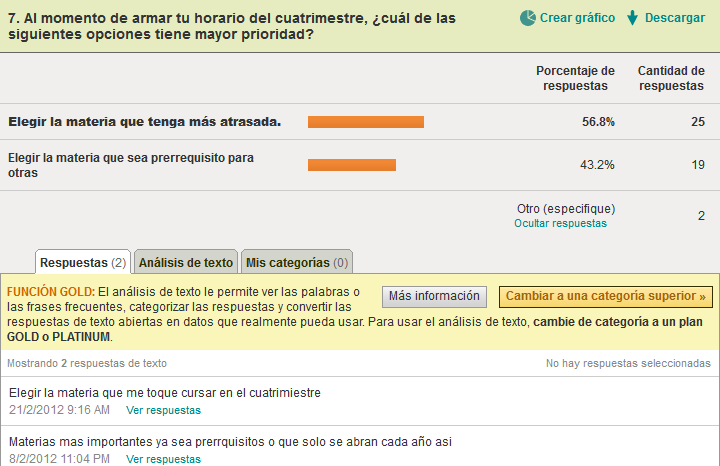 The image shows an extract of the survey. The image shows an extract of the survey.
The question says: When you are making your semestral schedule, which of the following options has the higher priority?
56.8% answered "To choose the most delayed course"
43.2%
answered "To choose the course that is a prerequisite for other"
The two other answers where "To choose the course that is assigned to my semester" and "Most important courses, when they are prerrequisited or when they can be taken only every year".
First we decided to create a small algorithm to assign a priority value to the courses which the student may take in a semester. For the calculation of the priority the following attributes are taken of each of the candidate courses:
1. Value of the semester: obtained as follows
(S +1) - s + (A-s) * 2
Where:
S = Total semesters throughout the race
s = Semester in which the course is registered
A = Semester of the highest candidate course
The multiplication factor was established as 2 because it allows giving a significant weight to taking a more delayed course.
2. Following courses: Number of courses which have as a prerequisite the candidate course.
3. Depth: The number of semesters it takes to attend a whole line of courses.
4. Courses involved: Total courses that are involved with the candidate course.
5. Topic of specialization: Within the curriculum exist terminal courses of specialization, according to the selected topic of specialty are the courses that the student must take. So in this case courses that are outside the specialty will be assigned with a lower priority.
If a student only visualizes the priority of candidate courses, he will not have a clear idea of how might be his schedule. That is why we decided to go a step further and investigate how a student creates his schedule.
For this research we chose to survey students of different college degrees through a tool called SurveyMonkey (Survey Monkey 2012). The results showed that most students consider the number of courses, the cost that their semester will have depending on the number of total credits and the courses that can be taken.
 The image shows an extract of the survey. The image shows an extract of the survey.
The question says: When are going to put courses in your schedule, whats the most important thing for you? (This question could have more than one answer)
20.5% answered "The cost of the semester"
61.4% answered "The number of courses"
36.4% answered "The courses that can be taken"
Other aswers were "The schedule of the course", "Courses according to my actual semester", "Avaliable schedules"
For this reason it was decided that the application can also calculate a schedule according to one of the criteria resulted in the survey and two more restrictions: 1) courses do not overlap in time and 2) to select the courses with the most delayed semesters. For this reason three options where added:
• Number of courses - the student writes the number of subjects that would take.
• Number of Credits - the student writes the maximum cost that is willing to pay and the system calculates the number of courses that might take.
• Without restrictions - the system calculates the semester in which the student is and the number of courses that he has yet to take to show an ideal amount of courses.
After setting our application we decided to test the results with some of the Student IDs that are registered in the system. We obtained very favorable results because the final schedules showed courses whose priority was high.
Finally, thanks to the ThinkQuest project our team achieved better communication when setting tasks and roles. Pair programming strengthened the development of the project because it is true that two heads think are better than one. Without doubt this contest is a great opportunity for young people to develop research capacity and innovation.
To make the system work you must have a database which has the mapping of the subjects a student has taken and subjects is blocked by not covering prerequisites. This "Courses planner" was developed by a student of the Bachelor of Information Technology UPAEP.
We consulted several books and manuals of MySQL(DuBois P., Hinz S. & Carsten P, 2005) and PHP(Achour M., Betz F., Dovgal A., Lopes N., Magnusson H., Richter G., Seguy D. & Vrana J., 2012) to improve and learn functions and statements used in the project
Fonts used in the menus and main titles were obtanied from a public domain font library(dafont.com, n.d.) and the loading image was generated by an Online Loading Generator(Loading Gif Image Generaor. 2012). The Javascrip function for the loading page was obtanied from Webmasterscv(Aguirre, H., n.d.).
Critical Thinkintg Worksheet
The Critical Thinking Worksheet can be downloaded here.
Source Code
Our whole source code can be downloaded here.
References
SurveyMonkey.(2012). SurveyMonkey: Free online survey software & questionnaire tool. Retrieved February 6,2012, from http://www.surveymonkey.com/
DuBois P., Hinz S. & Carsten P. (2005). MySQL® 5 Certification Study Guide. Sams Publishing
Achour M., Betz F., Dovgal A., Lopes N., Magnusson H., Richter G., Seguy D. & Vrana J.(2012). PHP Manual
PHP Manual. Retrieved April 20, 2012, from source http://php.net/manual/en/index.php
dafont.com.(n.d). Retrieved March 2, 2012 from source http://www.dafont.com/
Loading Gif Image Generator. (2012). Retrieved April 20, 2012 from source http://loadinggif.com/
Aguirre, H. (n.d.). Mostrar "Cargando Página Mientras carga la Web". Retrieved April 18, 2012 from source http://webmastercv.com/editorial/mostrar-cargando-pagina-mientras-carga-la-web.html
|















